Advisory — 1-Day AI Sprint
From operational reality
to board-ready AI decisions.
One working day with your team. Not a workshop, not an ideation session. A structured audit of how the work is actually done, scored against financial impact, and closed with two or three initiatives your board can fund.
Team reality first. AI solution second.
Why most AI programmes stall before the P&L
The common failure is not technical. Organisations select a technology, then look for a problem it might solve. Pilots multiply, adoption stays shallow, and nobody can attribute a euro of impact.
We invert the sequence. Before any discussion of models, agents or copilots, we map how a specific team creates value: what it does, how often, at what cost in effort, and what moves through each step. Technology is selected afterwards — and only where it earns its place.
What one day produces
-
10–20
Material operational inefficiencies mapped, quantified and ranked.
-
5–8
AI and automation opportunities scored on impact, feasibility and risk.
-
2–3
Execution roadmaps tied to a defined P&L or capacity effect.
-
1
Accountable owner named inside the business for each initiative.
The method
Three movements across a single day, from the widest view of the team's work to a short list of decisions with names attached.
-
Phase 1
Map the team reality
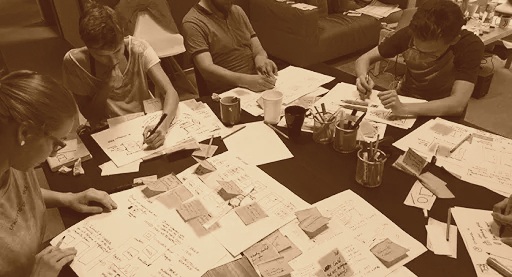
We break the function into its five to ten macro-activities, then decompose those into the tasks people actually perform — typically 100 or more. Each task is qualified by frequency and effort, and described as inputs, transformation and expected output.
Output — a complete operating picture of the team, in the team's own words.
-
Phase 2
Score by financial impact
Tasks are scored on concentration of effort, business criticality and technological feasibility, including whether the capability already sits inside your existing licences and platforms. High-scoring tasks are then reassembled into coherent end-to-end workflows rather than isolated features.
Output — a ranked shortlist, with the reasoning behind every position.
-
Phase 3
Close on an execution roadmap
For each retained workflow we fix the target solution, the CAPEX and OPEX envelope, the success metric, the decision gate and the internal owner. The day ends with a GO or NO-GO on each initiative, not with a list of ideas to be reviewed later.
Output — a sequenced roadmap that survives contact with a steering committee.
The funnel
Granularity is what makes prioritisation credible
macro-activities that describe the function
tasks and sub-tasks, scored on frequency and effort
workflows where technology creates disproportionate value
Ten generic use cases can be produced in an afternoon by anyone. Understanding a hundred real tasks is what tells you which three are worth funding.
How the day runs
Indicative sequence. Adapted to the function, its calendar and the seniority in the room.
- Opening
Framing with the sponsor: scope, constraints, what a good decision looks like at 17:00.
- Morning
Macro-activity mapping with the team, then task-level decomposition in working groups.
- Midday
Frequency and effort scoring. Identification of where the hours actually sit.
- Afternoon
Input–transformation–output analysis on the shortlisted tasks. Technology feasibility review against your existing stack.
- Late afternoon
Workflow reconstruction, prioritisation, owner assignment and cost envelope.
- Close
Readout to the sponsor. GO / NO-GO per initiative and first execution milestone scheduled.
How we hold ourselves to account
Decisioned
Share of identified initiatives leaving the day with a clear GO or NO-GO, an owner and a success metric.
Quantified
Share of prioritised initiatives carrying a financial impact — revenue, cost or risk — and a CAPEX/OPEX range.
Attributed
Share of approved initiatives with a named accountable owner, a timeline and a first execution milestone.
Who it is for
- A CEO, COO or functional executive accountable for a P&L or a cost base.
- A CIO, CTO or Chief AI Officer holding more candidate use cases than execution capacity.
- A team of 15 to 500 people in HR, Finance, Procurement, Operations, Legal, Sales or Engineering.
- An organisation that has run pilots and now needs attribution, not more experimentation.
What we ask of you
- One executive sponsor present at the opening and the closing readout.
- Six to twelve people who do the work, not only those who manage it.
- Visibility on the tooling already licensed and on the constraints that are non-negotiable.
- The authority in the room to say no on the day.

White paper — PDF, 10 pages
Team Reality First. AI Solution Second.
The full reasoning behind the Sprint: how the mapping is built, how tasks are scored, how workflows are reconstructed, and why the use case owner sits inside the business rather than in the AI team.
Read the white paperRequest the 1-Day AI Sprint brief
Tell us which function you have in mind. We send the detailed brief — scope, preparation, deliverables and terms — and propose a 30-minute call to confirm whether the Sprint is the right instrument for your situation.
Paris · Casablanca · Riyadh
Request received
We will come back to you within one business day with the brief and two proposed slots.